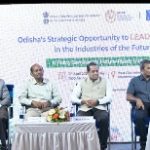
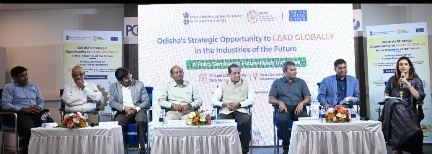
Bhubaneswar : Think Change Forum (TCF), in partnership with Bhubaneswar City Knowledge Innovation Cluster Foundation (BCKIC), Office of the Principal Scientific Adviser, Government of India, convened a policy seminar titled “Odisha’s Strategic Opportunity to Lead Globally in the Industries of the Future”, to discuss how Odisha can build its next phase of industrial growth through aluminium, bauxite and stronger downstream value chains.
The seminar examined how Odisha can translate Vision 2036 into real economic outcomes by strengthening the aluminium ecosystem as a driver of industrial depth, manufacturing competitiveness, jobs, sustainability and balanced regional growth.
Discussions at the seminar opined that aluminium remains underdeveloped despite Odisha holding the world’s fifth-largest bauxite deposits and 51% of India’s total bauxite reserves.
Participants noted that India imported about 3.6 million tonnes of bauxite in FY2023 and an estimated 4.5 million tonnes in FY2024–25, with a foreign exchange burden of around ₹4,000–5,000 crore, while finished aluminium imports crossed ₹70,000 crore in FY2025–26. Speakers said this reflects a wider economic cost of underutilising available mineral strength and a missed opportunity for jobs, industrial growth and regional development in districts such as Kalahandi and Rayagada.
Prof. Mrutyunjay Suar, Chairman, BCKIC, said, “For Odisha’s industrial transformation to be future-ready, it is essential to connect mineral strength with value-added manufacturing, local enterprise development and innovation-led growth.”
Participants noted that aluminium is becoming increasingly important for sectors such as electric mobility, renewable energy systems, transmission infrastructure, aerospace and defence, semiconductors and advanced manufacturing.
R K Sinha, Former Controller General, Indian Bureau of Mines, said: Aluminium is increasingly becoming a strategic material for next-generation manufacturing, and for Odisha, this creates a clear urgency to operationalise bauxite resources and link them to downstream value chains.The need of the hour is to responsibly unlock available bauxite reserves, resources to reduce import dependence, and create a more enabling pathway for downstream industrial growth. Equally important is the need to build trust at the community level by ensuring that local people are active participants in this development journey and can clearly see its economic and social benefits. This progress must also be anchored in meaningful Gram Sabha and community participation.”
The seminar also discussed the importance of projects such as the Lanjigarh refinery in creating downstream value and livelihoods.
Kalyan Charan Mohanty, Executive Director, Industrial Promotion and Investment Corporation of Odisha Limited IPICOL, said, “ The state has a clear vision to make aluminium a more integral part of Odisha’s industrial development over the next five to six years.”
Prof. Nilanjan Banik, Economist and Program Director, Mahindra University, remarked: “Lanjigargh refinery amongst other several projects are a case in point. Economic integration at scale can happen only when all stakeholders — regulators, policymakers, industry and communities are aligned behind a shared development pathway. Bauxite-led Industrial Corridor will be a solution to creating local economic transformation in the mineral rich regions.”
Estimates cited during the discussion suggested that operationalising just three bauxite mining clusters could add around ₹18,000 crore annually to the state’s GSDP, create nearly 15,000 direct jobs and over 50,000 indirect jobs, and attract close to USD 2.5 billion in downstream investment.
Dr. Chinmay Sarangi, Senior Principal Scientist, CSIR-IIMT, said: “India’s transition into advanced manufacturing will be critically dependent on advanced technology for materials innovation, particularly in aluminium and allied sectors. Odisha is uniquely positioned, but the real opportunity lies in moving beyond extraction to building research-led, technology-driven industrial capabilities that support high-value applications and critical metal value recovery with waste valorisation, and industry has an important role to participate.”
Ravikant Muddu, COO, Innocule, said:“For aluminium-led sectors to scale, the state needs predictability, infrastructure and stronger downstream linkages.”
Dr. Manoranjan Mohanty, Deputy Director General (Retd.), Geological Survey of India, said:“Industrial depth is a function of value chain integration. Without downstream expansion, upstream capacity alone cannot deliver sustained economic multipliers.”
Dr. Nihar Ranjan Sahu, Former Chief Environmental Engineer, State Pollution Control Board, Odisha, said: “Any expansion of bauxite- and aluminium-linked industries must be anchored in credible environmental governance and responsible mining practices.”