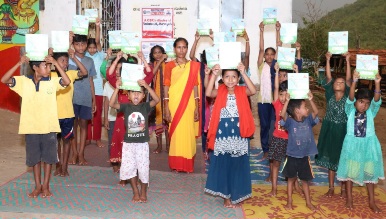
Bhubaneswar: Vedanta Aluminium has been extensively supporting this unique model’s expansion in the region with nearly 400 such schools in Kalahandi and Rayagada supported by the company,taking the project’s transformational impactbeyond classrooms and into communities. The company’s efforts go beyond financial support and extend to onboarding teachers, providing learning materials and linking classroom education with practical awareness sessions through its wider community programmes.
Each of the Ekal Vidyalayas is designed to eliminate access barriers as far as possible,helping ensurethat children in the 6-10 age group have access to foundational learning opportunities. Classes are held within the village, often in open or shared spaces, led by a teacher/Acharya, drawn from the same or nearby community. This ensures familiarity, language alignment and continuity.
Alongside this, the company’s additional interventions in sanitation, health and nutrition further augment the ecosystem within which these schools operate. While Ekal provides the foundation, its effectiveness deepens when supported by aligned community initiatives. In many villages, classroom awareness is reinforced through Vedanta’s ongoing awareness programmes, creating continuity between learning and practice.
For instance, sanitation awareness introduced through Ekal is complemented by Vedanta’s Project Nirmal, which focuses on improving hygiene practices, menstrual awareness and community-level behaviour change. Similarly, nutrition awareness is supported through Vedanta’s Pehli Udaan and Shishu Sanjeevni programmes, which engage families on child health and dietary practices.
Health awareness follows the same approach. While Ekal teachers introduce basic understanding of illness and prevention, Vedanta’s Mobile Health Units (MHUs) provide doorstep healthcare services across remote regions. Thecombined effect is visible at the household level. In many villages, children emerge as the first point of information for families.
Bibhisana Majhi, parent of a student, reflects on this shift, saying ” Now my children read and explain things to us, about cleanliness, health and what we should do. It helps everyone.”
Marchana Jalia, an Acharya from Renda in Kashipur block of Rayagada, explains, “Because the school is in the village and the teacher is from here, parents trust it. Children come regularly. It becomes part of daily life.”
Strengthening last mile development, Odisha today has over 4,600 Ekal Vidyalayas, with a significant presence across tribal belts. Supported by Vedanta’s broader community development initiatives, the Ekal Vidyalaya model demonstrates how aligned interventions can strengthen outcomes at the last mile.